
It usually starts small. Maybe a sound that is suddenly too loud, or a plan that changed without warning. Then, over the next minute or two, you are making a dozen decisions at once: whether to talk or go quiet, whether to clear the room, whether the headphones will help or make things worse, what to tell the sibling who is asking what happened — with your own heart going and dinner still on the stove.
Nobody makes good decisions in that minute, the adult included. The trick is to make them earlier, on a quiet Tuesday evening when nobody is upset, and to write them on one page that you, or whoever is with your child, can read instead of working it all out live.
Four headings, one page
A calm-down plan needs four headings, and each one fits in a few lines.
- The first signs. What you see before it starts, in plain words and as specific as you can make them. "Gets wound up" is hard for anyone else to spot, while "starts asking the same question over and over" or "goes very still and stops answering" is something a grandparent can notice from across the room. Write down the earliest sign you know, because the earliest one buys everyone the most time.
- What helps. What has actually worked in your house, in the order you try it. Name the real thing and where it lives: the gray headphones in the basket by the back door, the beanbag in the corner of the bedroom, the one song that works in the car. Every adult already carries a general list of calming ideas; what they lack is your child's version.
- What makes it worse. Often the most useful heading for someone else, because it catches what a kind adult does by instinct. For some children that is being asked what is wrong. For others it is a hand on the shoulder, a second adult coming in to help, or a deal offered halfway through. If you know something backfires in your house, it goes on the page.
- What the grown-up does first. One line for you: whatever gets you steady enough to follow your own list, like a slow breath before you say anything. It can feel odd to put yourself on a plan about your child, and it may be the line that makes the other three possible.
Keep the whole thing to one page, in the words you would use out loud. The person reading it might be your partner, a sitter on their second visit, or you at your most frazzled, and all of them need to take it in at a glance.
Write it on a quiet evening
This works on a Tuesday night for a simple reason: on a calm evening you can remember. Think back over the last three or four hard moments and ask the same questions of each one — what did I notice first, what finally helped, and what did I try that made it worse. Things that are invisible from inside a hard afternoon show up quickly once a few of them sit side by side.
If you keep any kind of log, open it. Any notebook, phone note or text thread works if each entry has a time and a line about what happened. Read the entry just before each hard one and look for whatever keeps turning up beside them. Nothing has to be proven to earn a place on the page, and something that shows up three times has earned it.
Then ask the other adults. The other parent, a grandparent, a teacher or aide, a therapist who has seen your child have a hard time: each of them has watched moments you missed, and each may know a first sign you have never seen. A teacher might tell you that at school it starts with chewing on a sleeve, long before anything you would call upset. One question in a text — what do you notice first? — fills in what one parent cannot see from one spot in the house.
Then write the page. Once the thinking is done it takes about twenty minutes, and it is worth putting the date at the top so that in six months you know how old it is.
A made-up example
Here is one for a made-up child, borrowing a few details from the demo profile in the screenshots further down:
- First signs: goes quiet at dinner and tugs at the neck of her shirt; covers her ears at sounds the rest of us barely notice.
- What helps: the noise-cancelling headphones on the hook by the back door, then the pile of pillows in her room, which she likes to crash into. Fewer words from us.
- What makes it worse: questions, anything wet on her face or hands, hand dryers when we are out, and a second adult arriving to help.
- Grown-up first: one slow breath before saying anything, and the phone face down on the counter.
Each line names something a grandparent could see or do without phoning anyone first.
Why it has to leave your head
In our house, most of our son's care lived in my wife's head. The only reason I knew that was because every time someone else watched him — a sitter, a grandparent, a substitute teacher — she had to dictate the contents of her head out loud, in real time, and half of it still didn't transfer.
A calm-down plan kept in one parent's memory has the same problem, and it shows up at the worst possible moment. The person who knows the plan best might be at work or in the car, or might be the one whose own patience ran out ten minutes ago. Once it is written down, whoever happens to be in the room can follow it.
So put copies where the next adult will actually be standing: taped inside a kitchen cabinet door, in the folder that goes to a sitter, as a photo on the other parent's phone, and at a grandparent's house if your child spends time there.
Look at it again after a hard one
The plan improves every time it gets used, as long as you come back to it afterward — later that night or the next day, once everyone has recovered. Add a line about what you noticed first this time and whether the list held up. If something under what helps has stopped working, cross it out.
Children change, and a plan from last spring can go stale without anyone noticing. A new school year or a new baby in the house is a good reason to read it again.
One boundary is worth saying plainly. A calm-down plan is for the ordinary hard moments. If your child's hardest moments can put anyone in danger, that calls for a bigger safety plan written with the professionals who know your child, and a page on a cabinet door is no substitute for it.
Keeping the plan in CareHaven
CareHaven is the app I am building to carry exactly this kind of detail, and two of its screens line up with parts of the plan. The Sensory Profile holds what helps and what to avoid, one sense at a time. Calm Tools is somewhere to go for the grown-up-first line. These steps assume you have never opened the app.
The Sensory Profile
If you care for more than one person, check the name in the colored pill at the top center of the screen before you start. The profile belongs to whoever is showing there.
- Tap the Main Menu button at the bottom left of the screen, then tap Care Plan.
- Scroll to the section headed Context and tap Sensory Profile. Its subtitle reads "Per-channel calms / avoids / seeking."
- The screen lists eight senses, each on its own card: Visual, Auditory, Tactile, Smell, Taste / Oral, Vestibular, Proprioceptive and Interoceptive. An empty card reads "Tap to set" with a few examples.
- Tap a card, for example Auditory, and it opens in place. Under Tendency, pick Avoiding if this kind of input overwhelms your child, Seeking if they crave more of it, Mixed if it depends on the day, or Typical if there is nothing notable.
- Under Notes, write a line about how your child responds. Then fill in What calms / helps and What to avoid.
- Tap the save button at the bottom of the card, which carries the sense's name — here it reads Save Auditory. The card closes and shows your note, with what helps in green beside a check mark and what to avoid in red beside an X.
If Sensory Profile is missing from Care Plan, tap the Menu button in the top-left corner (three lines), then Settings, then Menus, then Hub sub-sections. Under Care Plan, switch Sensory Profile on and tap Done. If Care Plan itself is missing from the Main Menu, the same Menus screen has a Main Menu row that shows or hides whole hubs.
Calm Tools
- Tap the Main Menu button at the bottom left, then tap Caregiver.
- In the section headed Right now, tap Calm Tools.
- Four tabs run across the top: Breathe, Timer, Cards and Kind words. Breathe opens first, with Box breathing selected and 4-7-8 breathing next to it.
- Tap Start. The circle grows and shrinks and counts each step for you, following the line underneath it: Inhale 4 · Hold 4 · Exhale 4 · Hold 4 for box breathing. Tap Pause to stop, or Reset to go back to the beginning.
- After one full round, a How are you now? button appears under the count. Tap it for a short check-in titled "Back in your window?" Tap I'm steadier now if you are, and go back to your list. If you are struggling, I'm not okay — reach 988 dials the 988 crisis line.
The other tabs are for other kinds of minute. Timer is a plain countdown with presets from 1m to 30m, for when another adult has taken over and you need a minute to reset. Cards is a grid of ten quick grounding prompts, like 5 things you can SEE and Drink cold water. Calm Tools also has its own section on the Safety & crisis plans help page.
-
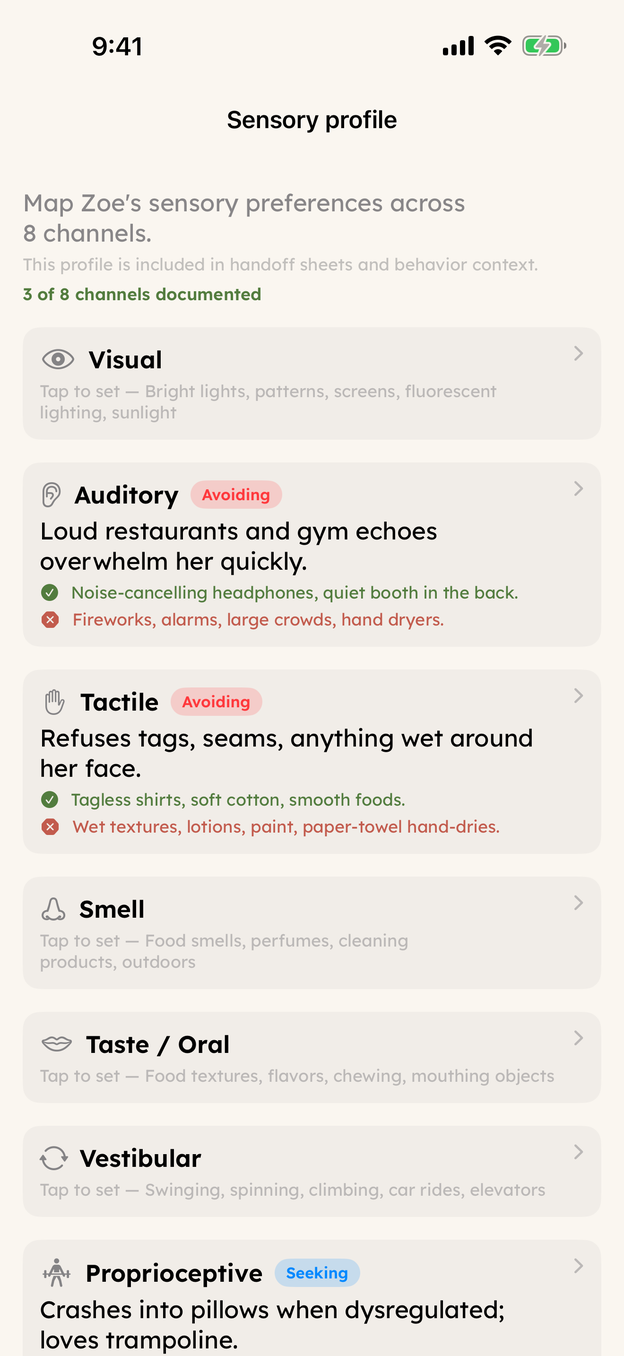
The Sensory Profile on demo data. Each finished card shows a tendency, a one-line note, what helps in green and what to avoid in red, which are the middle two headings of a calm-down plan, one sense at a time. -
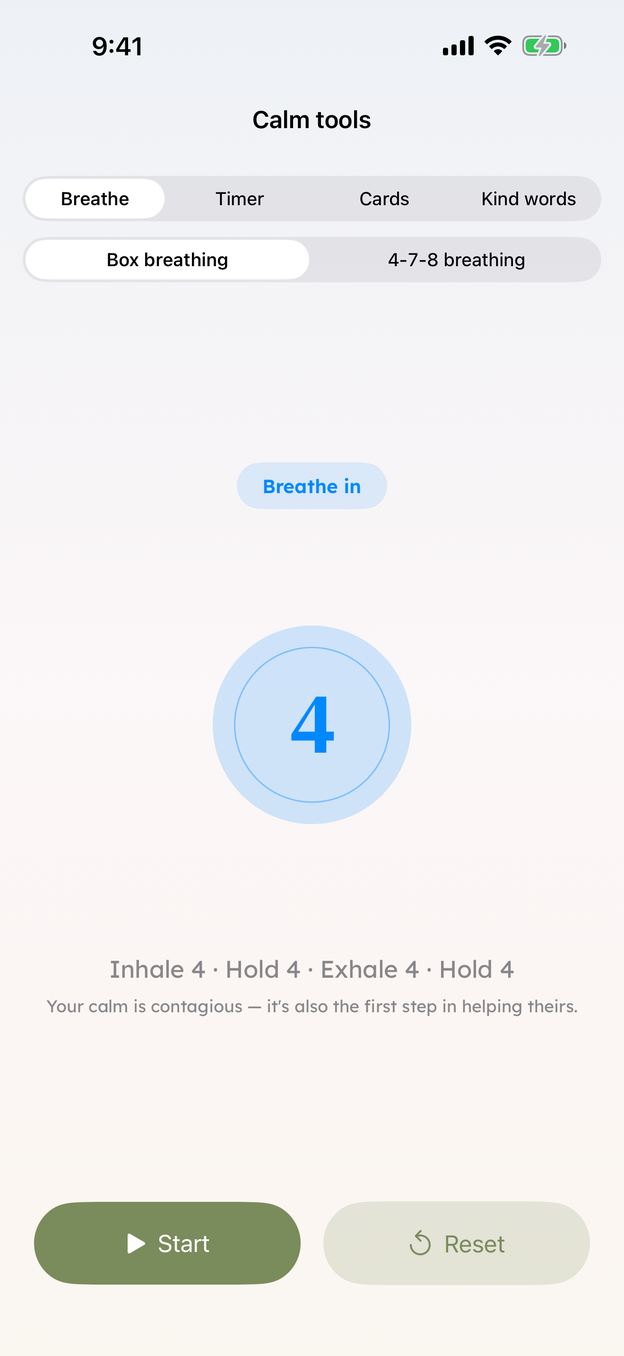
Calm Tools on the Breathe tab, with Box breathing selected. Tap Start and the circle counts each step for you, so the only thing to follow is the number.
The whole plan is four headings and about twenty minutes, and the right time to write it is an evening when nothing is wrong. If tonight is one of those, start with the first signs. You know them better than anyone, and they are the heading that gives everyone else the most time to use the rest.
CareHaven is in open beta
Everything above is in the app. It is free while in beta, all your care data stays on your device, and you can walk away with a full backup at any time.
Join the iPhone beta →