Daily tracking
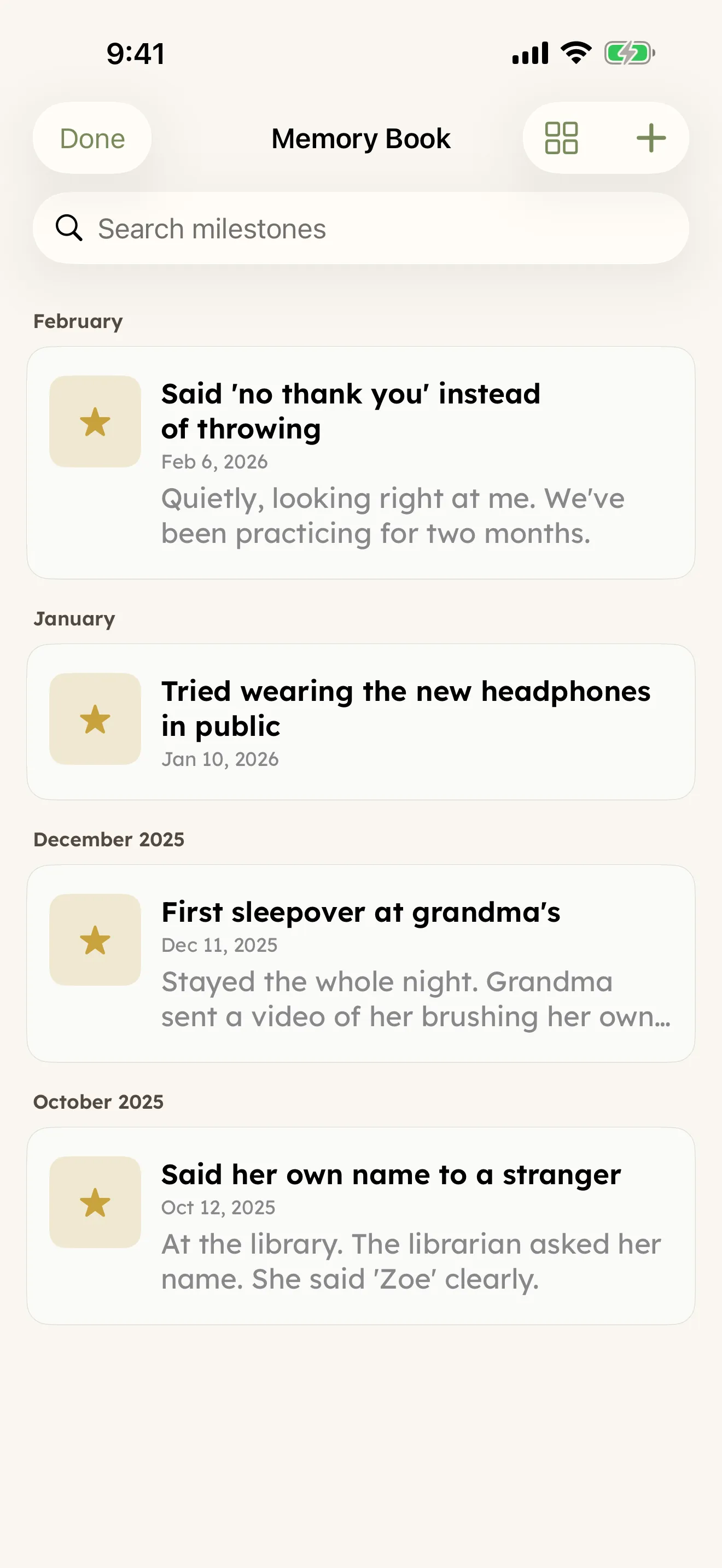
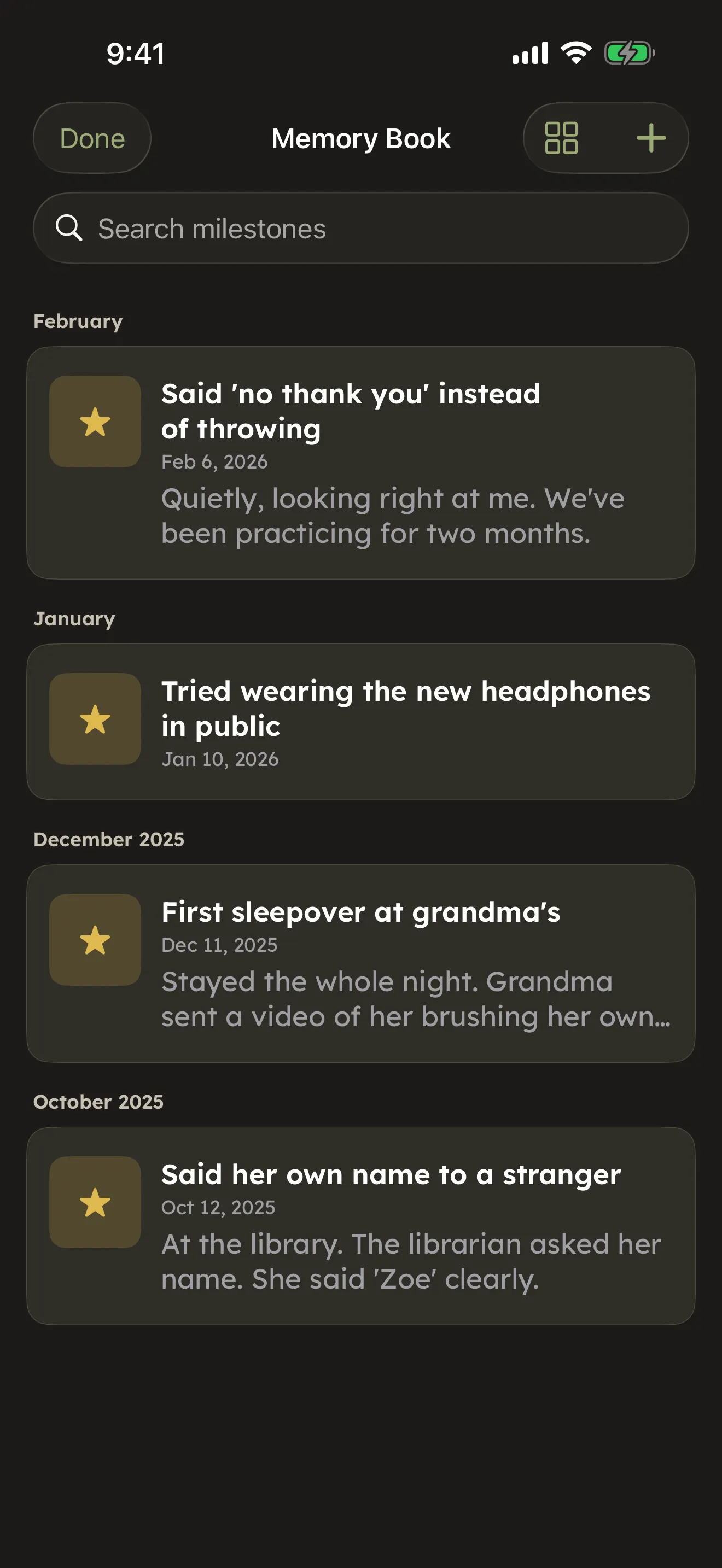
These are the logs you reach for most, the small things you note dozens of times a day. Each one is built to be fast to add and easy to look back on. None of it asks you to be clinical. You jot what happened, and over time the app helps you see the patterns underneath.
On this page
Your care log lives on your device and, if you turn on sync, is reachable only by the people you specifically invite into your circle. Look back at a single day on the Home screen, or search across all of it with Search & Ask CareHaven.
The timeline (your day at a glance)
The timeline is the heart of CareHaven, a running list of everything that happened for the person you care for, in order. Medications, wins, behaviors, triggers, and health notes all land here together. Available
To add something, tap the + button (bottom center, "Log an event"), choose a type from the quick-log grid, write your note, and save. Tap any entry to open it for full detail, inline editing, or delete. You can attach a photo to any entry, useful for documenting a rash, an injury, or wound healing. Timeline photos stay on your device — they are not part of sync — and are only shared elsewhere if you choose to include them in an export.
A few gestures make the timeline faster to work with: long-press an entry to copy its text to your clipboard, and swipe left to delete it (with a confirmation). Medication entries show a given or missed status, tap to change it. Tap the Today's Timeline heading itself to collapse the entry list when you want a cleaner view, your collapsed state is remembered. How much of the day shows at once (Today, 3 days, or 7 days) is set in Settings → Display.
Quick Note
Tap: + (bottom center) → Quick note
When you just need to capture a moment, the quick note types let you do it in seconds, no separate screen to learn. Available
The types are:
- Mood — a general wellbeing note
- Behavior — links into the behavior log
- Win — positive moments and breakthroughs
- Trigger — what caused a difficult moment
- Health — symptoms, illness notes, observations
A small idea that pays off: use the Win type generously throughout the day. The Growth view will show a rising "Positive Wins" line, and on a hard week, that list reminds you how much progress is actually happening.
Feeding
Tap: + (bottom center) → Feeding — or Main Menu (bottom left) → Track → Feedings
The feeding log tracks what was offered and how it went, without judgment or pressure. You decide what, when, and where; the person decides whether and how much. (This is Ellyn Satter's Division of Responsibility model.) Available
Type a food name (autocomplete suggests common foods as you go), enter the amount in grams (tap the scale icon if you need help estimating), and pick a response:
- Accepted — ate it. Any amount counts.
- Explored — touched, smelled, licked, or held it. This is real progress in food-chaining work.
- Refused — would not engage.
If a food was refused or explored, you can add a sensory reason (texture, smell, temperature, sound, appearance). On a new entry, the app gently pre-fills from yesterday's same-time pattern so there's less to type. Over a few weeks, logging exploration and sensory reasons consistently gives a feeding therapist (an SLP) the kind of specifics that shape a real plan. A couple of patterns worth the discipline: in feeding therapy the Explored response matters as much as Accepted, so log it every time, and after 8–12 weeks you'll have a chart of progression up the food chain to show the SLP. Logging refused foods with their sensory reason consistently lets you later sort by, say, "Texture" and see that smooth textures get accepted while mixed ones are always refused, the kind of specificity that shapes a treatment plan.
For young infants, you can turn on bottle tracking in Settings → Display → Show Bottle Tracking, which adds a separate bottle log in ounces alongside food entries. A separate pumping log is also available if you need it.
Feeding-refusal alert
A Care alert that watches for a run of refused meals. From the Feeding hub, tap "Care alerts" -> Feeding-refusal alert, turn it on, and set how many refusals over how many hours; CareHaven raises a Care signal when that many refusals are logged inside the window. It is off until you set it, and when it is on it becomes the single refusal nudge — it takes the place of the older built-in mealtime refusal hint, so you set the threshold rather than relying on a guess. It only reflects what you logged against the threshold you chose. A run of refusals can point to pain, illness, or a swallowing problem — worth raising with your doctor or a speech-language pathologist. CareHaven counts the refusals you logged; it doesn't diagnose the cause. See Safety & crisis plans. Available
New foods (introducing a food over time)
Tap: + (bottom center) → New food — or Main Menu (bottom left) → Track → New foods
Where the feeding log tracks a day's meals, New foods tracks one food's whole journey — the weeks of small, patient attempts it can take before something new lands on the menu, especially with ARFID or another feeding difference. Each food you're working on gets its own page, and every attempt is logged on a gentle ladder where every rung counts: in the room, at the table, smelled it, touched it, tasted it, swallowed a bite. "Didn't engage today" is a valid entry too — offering it counts. Available
Each attempt can also carry how much they had, how they reacted (stayed calm, was curious, texture bothered them, ...), their mood, and whether the new food was offered alongside a safe food. The food's page shows the furthest step so far and how many times you've tried — framed as the best moment yet, never a score. When a food genuinely lands, mark it accepted and tap Add to safe foods to graduate it onto the Preferred foods list (linking to an existing entry if it's already there, so you don't get duplicates).
New-food attempts never create feeding entries or touch nutrition totals — log meals in Feeding, log the introduction project here. The full walkthrough, including the complete step ladder: Introduce a new food.
The New foods row can be shown or hidden per person — if you don't see it, check Settings → Menus.
Pumping (breast-milk sessions)
A dedicated log for breast-milk pumping sessions, kept separate from feeding because pumping is your activity, not the baby's intake. It tracks the time, how long you pumped, how much you got, where the milk went, and any notes for each session. Available
Turn it on. Pumping is hidden by default. Enable it in Settings → Display → Show Pumping Tracker. Once it's on, reach it from Main Menu → Track → Pumping. If you want to change which sections show up, you can do that in Settings → Menus.
To log a session, tap + Log Session. The date and time default to right now, so adjust them for a retroactive entry. Enter the duration in minutes, pick your unit (ml or oz, and your choice carries over next time), then enter the total amount — or tick Track each side separately for left/right inputs that add themselves up. Tap one of 🧊 Frozen, ❄️ Fridge, or 🍼 Served for where the milk went, add a note if it helps (let-down speed, which pump you used, anything worth remembering), and tap Save Session.
Once you have any sessions logged today, a summary card at the top shows the total amount, total minutes pumped, and the session count — handy for matching the baby's intake or tracking supply trends. Tap any session card to open its detail, where you can edit any field or delete the session (deletes are confirmed first).
Pumping data lives alongside your other care logs. It's included in encrypted backups and, like the rest of your care log, syncs to your other devices and anyone you've invited into your circle if you turn sync on. It's never used in any smart-help context.
Potty
Tap: + (bottom center) → Potty (or Toileting for adult profiles)
A quick log for continence, accidents, and toilet-training progress. Each entry records wet, BM, or a dry check, plus a note and time. Available
The notes field is where the useful detail lives, consistency, color, skin condition, any sign of discomfort. For a child with a GI condition, that turns into a diary a gastroenterologist genuinely finds useful. If you're working toward toilet training, logging dry checks at intervals first shows you the natural window when the child is most reliably dry.
Behavior (with gentle ABC notes)
Tap: + (bottom center) → Behavior
The behavior log treats behavior as data, not judgment. You log what you see, in a few kinds — Stims (🔄), Tantrums or meltdowns (🌊), and Positive behaviors (⭐) — with a short description and time. Available
To log one, go to the Behavior tab, select the type, write a brief description in the text field, and tap the type button again to save (or tap + Log). Tap any logged behavior to open its detail sheet, where you can edit the type, description, and time, or delete the entry.
To go deeper on a tough moment, an entry can hold the ABC picture: what happened right before, what the person did, what happened after, and what helped. Looking at all three parts is how triggers and patterns become visible. After you've logged two or more behaviors, a quiet 🔍 help me understand today's patterns option appears that hands the question to Ask CareHaven, with obvious identifying details stripped first on a best-effort basis.
A worthwhile habit: log stims as neutral facts and aim for several positive entries for every difficult one. It isn't denial, it's building an accurate picture.
Behavior Insights
When it notices something worth a gentle word, Behavior Insights reads back across your own logs and offers up to three quiet, observational nudges, never alarms, never advice. Available
They might tell you regulation has been running low lately (and point you to your saved crisis plan and what's helped before), that behaviors have picked up this week, or that a particular strategy keeps being followed by calmer check-ins. The thresholds are your own, the levels you set when you check in, and nothing is sent off the device to produce them. Each nudge is just a shortcut to the thing that helps. Follow the one that fits the moment; ignore the rest.
Growth (trends, streaks, and wins)
The Growth view turns your logs into visual trend charts over the past four weeks, alongside your streak and XP, recent milestones, and a quick summary of today's stats. Available
- Med Compliance — the percentage of doses given versus scheduled
- Positive Wins — the count of ⭐ Win entries each week
- Behaviors (↓ good) — the tantrum and meltdown count, where lower is better
Tap any chart header to expand it for a taller, more detailed view. A small habit that pays off over time: take a screenshot of the Growth view on the first of each month. After six months you have a visual record of how things have changed — medication compliance, behavior trends, win frequency — and that narrative arc is powerful context at any annual review.
Patterns (every metric as a trend)
Patterns is the chart layer for everything you log. Every loggable item — feedings, behaviors, seizures, sleep, mood, vitals — surfaces here as a trend, so you can spot the regressions before they become emergencies and see which interventions are actually working. Available
You'll see a trend line per metric (feeding count, behavior intensity, seizure frequency, sleep total, regulation level), side-by-side overlays so a med change in March visibly bends the behavior line, and anomaly callouts like "behavior frequency this week is 2.3× the 30-day baseline." When more than a paragraph of context is genuinely useful, a plain-language summary is generated right on your device. Patterns is also the source for the Home screen's Behavior Pattern Nudge card — a quiet "your data suggests" surface that doesn't shout but stays visible until you acknowledge it.
Bring Patterns to clinical visits on your phone. A clinician can take in two months of seizure frequency from a chart in five seconds; rebuilding that from memory takes thirty minutes and is less accurate.
Regulation check-in
Tap: + (bottom center) → Regulation check-in — or tap Check In directly from the bar at the top of the Home timeline.
A quick read on how regulated the person is right now, on a five-step scale from calm to crisis. It sits at the top of the day view. Available
Choose one of the five levels, and optionally add a short note ("wound up after the bus ride"). The last level and time stay on the bar. You can also log it from your Apple Watch.
Log it at the same few moments each day, home from school, after dinner, before bed, and after a few weeks reliable patterns show up. "She's almost always tense by Thursday evening" is real data you can bring to a therapist or school team. If you share shifts, logging regulation at handoff time tells the next caregiver exactly what state the person is in, no long briefing needed.
Sleep
Tap: + (bottom center) → Sleep / nap
Log bedtime, how long it took to fall asleep, night wakings, wake time, and an overall quality rating. A seven-night chart shows the trend at a glance. Available
Sleep quality quietly shapes mood, focus, and how well medication works, so a four-week sleep log is something worth bringing to a psychiatry appointment. "He's been averaging 3 out of 5 for six weeks" tells a clinician far more than "he doesn't sleep well." Comparing the sleep trend against the behavior log often reveals a correlation, more difficult days after poor nights, that can genuinely change clinical decisions.
Sleep alert
A sleep alert watches for short nights. From the Track hub, tap "Care alerts" -> Sleep alert, turn it on, and set a minimum number of hours, a number of nights, and a window; when that many logged nights fall under your minimum inside the window, the signal fires. It is off until you set it. It reads only the nights you actually log in the Sleep Log, so it reflects logged sleep only — it never claims how your person actually slept, and it won't fire just because a night wasn't recorded. Short sleep often shows up before harder days — pairing this with the Behavior Log can make the connection visible to your care team. See Safety & crisis plans. Available
Seizure (with a live stopwatch)
Tap: + (bottom center) → Seizure
Built for the moment a seizure happens, minimal taps, maximum data. Pick the type, tap Start Timer when it begins, and Stop when it ends so the duration is captured precisely. There's a five-minute "consider 911" warning, and the running timer shows up on your Lock Screen and Dynamic Island so you can stay with your person instead of staring at the app. Available
Afterward you can add post-seizure notes and mark whether rescue medication was given or 911 was called. The whole history exports as a clean PDF for a neurology appointment.
This is just the quick version. For a step-by-step, see Walkthrough: Log a seizure with the timer. For rescue-med plans, first aid, and what counts as an emergency, see Safety & crisis plans.
Cycle
Tap: + (bottom center) → Cycle entry (appears only for female profiles; if it isn't showing, it can be turned on in menu icon (top left, three lines) → Settings → Menus → Quick Log (+))
A private, discreet cycle log for female care recipients, flow heaviness and product used. It only appears when the person's profile is set to female, and it can be hidden in Settings if it isn't relevant. Available
For many neurodivergent girls and women, dysregulation, meltdowns, and anxiety rise significantly in the days before a period (a PMDD-adjacent pattern). Logging cycles consistently and comparing against the behavior log makes that pattern visible — after three or four cycles it often becomes unmistakable, and it's highly actionable for a care team.
Diary
Tap: + (bottom center) → Diary entry
A personal journal for the full story behind the data, longer entries, photos, and a private toggle. This is where you write what the logs can't hold. Available
Go to the Diary tab and tap + New Entry. Write a title and the full entry, attach a photo from your camera roll if you like, and toggle Private if it should never appear in a shared report. Private entries (🔒) are visible only to you and excluded from every export — use them for your own emotional processing and the hard days you just need to get down. Shared entries can ride along in a handoff. When a day is genuinely terrible, write it down privately not to analyze it but simply to record it; over months you'll be able to see how many hard days there really were relative to good ones, and that perspective matters when you're in the middle of a hard week. A dated diary entry after a breakthrough or a conflict at school also becomes powerful evidence at an IEP meeting. CareHaven can even draft a diary entry from the day's events to get you started — drafting is part of CareHaven Plus.
Routines
Tap: Main Menu (bottom left) → Track → Routines
A visual daily schedule of time-tagged steps with a completion tracker, predictable, visual, and calming. Available
Add each step with a time, an emoji icon, and a task name, then drag to reorder. During the day, tap the circle beside a step to mark it done; the progress bar and percentage update as you go, and completions reset at midnight.
How often it repeats. When you create or edit a routine, the Repeats section sets its cadence: Weekly (every day, or only certain weekdays — tap the day pills), Monthly (a day of the month, or the last day), or Yearly (a month and a day). A monthly or yearly routine only shows up on its scheduled day — a "replace the feeding-tube extension on the 1st" chore appears on the 1st, not every day, and the same is true on the calendar. Turn on Remind on this device for a gentle notification at the routine's time; monthly and yearly reminders are scheduled a few occurrences ahead and quietly top themselves up as each one passes. If you pick the 29th, 30th, or 31st (or "last day") for a month that's shorter, it lands on that month's last day rather than skipping — so a month-end chore never falls through the cracks.
You can also mark a whole routine done in one motion: swipe left on an active routine row and a green Mark done action appears — tap it or full-swipe to confirm, and the row gets a green checkmark and a success haptic. If it's already done today, the action reads Done today in a softer color and tapping does nothing, so a re-swipe out of habit never adds a duplicate. A streak chip ("3-day streak", "5-day streak") shows in the row caption once you've kept it going two or more days in a row; it counts back from today and breaks if a day is missed. Every completion is kept in that routine's own history. Tapping the row (rather than swiping) still opens the routine runner sheet so you can step through the full checklist.
Before a respite worker or sitter arrives, the emoji-led routine maps the whole day for them without a long verbal briefing — screenshot the Routines tab and text it over, and the icons carry the day even if they haven't read the notes. You can also keep two versions of the same routine, one with every step and one with the key steps only, and move from the detailed version to the simplified one as the person learns the sequence; the Growth view shows how completion holds up as you do.
Preferred foods
Tap: Main Menu (bottom left) → Track → Feedings (then open Preferred foods from within)
A two-tier list of what the person eats safely and what's currently off the menu, especially valuable for ARFID, food allergies, sensory eaters, and post-procedure diet limits where one wrong choice means a refused meal or worse. Available
- Loves — the safe, reliable foods. The first place a new caregiver should look when meals turn into a fight.
- Avoid — items that trigger refusal, allergy, sensory overload, or a known reaction.
Each item can carry a reason and notes (sauce on the side, a specific brand). Preferred foods are bundled into the handoff packet so a substitute caregiver doesn't have to guess. A handy trick: photograph the package label for safe brands, so the wrong flavor never sneaks in.
Life changes
Tap: Main Menu (bottom left) → Track (then scroll to Life changes in the hub)
Big events shift behavior, a move, a new sibling, a hospitalization, a parent traveling, a pet passing. Logging the event lets you tell the difference between a real regression and a predictable reaction to a known disruption. Available
From the Track hub or the Home timeline, tap + Life Change, pick from a grid of common events or type your own, and set the start date (and an end date once it resolves, which moves it from Active to Past). Active life changes show up in the handoff packet so the incoming caregiver knows what's pressing on the person right now. They also feed the app's smart help so its read of a confusing week has the right context.
Log the event the day it starts. A behavior pattern that baffles you today often makes complete sense later, once it's paired with a life change you wrote down.
Looking for medications, vitals, or doctor visits? Those live in Medical. For goals, milestones, and the cue guide, see Advocacy & goals. Tracking something the app doesn't have a built-in log for yet — nosebleeds, hydration, a mood dip? See Custom trackers.